
What it is
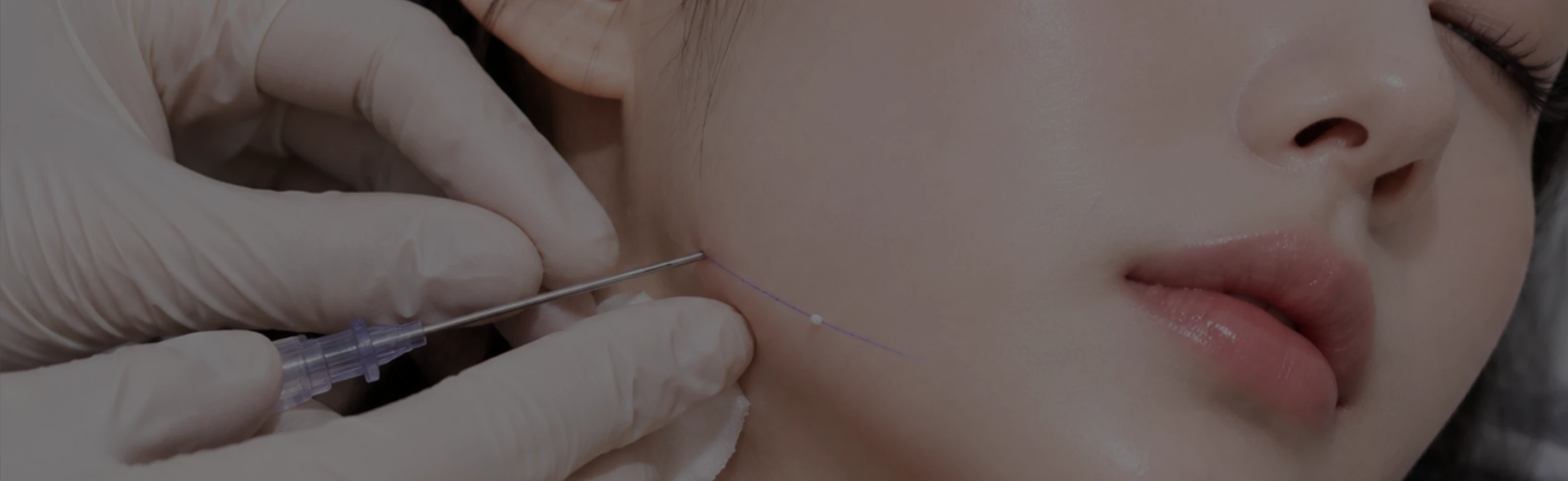
There is no incision. Using a blunt cannula, the doctor places threads under the skin. Barbed sections catch the sagging tissue and hold it in the planned direction. The direction is visible right after placement. Over the following weeks the body forms collagen around the threads, which is a normal tissue response.
Violacell mainly uses absorbable threads. Some products combine a non-absorbable suture with absorbable cones. Which kind you get affects how long it stays in your body and what can be done later, so ask before the procedure.
Why each area is planned separately
A face does not drop evenly in one direction. The forehead, the nasolabial area and the area under the jaw sag in different directions and at different depths, so one path cannot cover everything. Areas that need lifting force and areas that need better skin texture call for different threads at different depths.
The order is: decide the direction and how much lift first, then plan the path, and only then the number of threads.
Types of thread
- Lifting threads: barbed threads that catch and lift tissue. Main areas: front cheek, deep cheek, double chin.
- Volume threads: placed under hollow areas to add a little volume. Used for forehead, front cheek and nasolabial folds.
- Firming threads: smooth threads without barbs, used for forehead and deep cheek.
- Detail threads: very fine threads for fine lines and small areas such as the nasolabial folds and forehead.
Material and structure change both the lifting force and how long the thread takes to absorb. The combination depends on which areas you want to lift and by how much. Barbed and smooth threads are often combined in one plan.
Five treatment areas
- Forehead: when it looks hollow or has fine lines. Volume threads for hollows, fine threads for lines. Forehead shapes vary a lot, so this needs careful work.
- Front cheek: when the front of the cheek has dropped and the face looks less defined.
- Nasolabial folds: when the folds are visible even without smiling.
- Deep cheek: when the cheek beside the mouth corners has dropped and looks heavy.
- Double chin: when the jawline is blurred and the area under the chin is loose.
You can name only the areas you care about. Threads go only where they are needed. What is possible depends on the area and on your condition.
Thread lift versus a surgical facelift
- Incision: a facelift cuts and lifts tissue; a thread lift uses a cannula and no cut.
- Anesthesia: a facelift usually needs general anesthesia or sedation; threads use topical anesthesia.
- Time: a facelift takes hours; a thread lift about 20 to 30 minutes.
- Recovery: a facelift needs recovery time and stitch removal; after threads most people return to daily life the same day.
- Duration: a facelift lasts longer but repeating it is a bigger step; thread results depend on absorption time and vary.
If the skin is very loose or there is a lot of excess skin, threads can only do so much, and the doctor may suggest another approach. Listen to that advice.
Two thread-related manufacturer plaques are on display at the clinic: Silhouette Soft (Sinclair) user clinic and i-THREAD (Healux) thread lifting education center. Which thread is used is decided by area at consultation.
How it is done at Violacell
- Duration: about 20 to 30 minutes.
- Anesthesia: topical.
- Discomfort: moderate (varies by person).
- Downtime: most people can go about their day as usual.
- Photo analysis: visitors can start with an Evelab AI skin analysis, used in the first consultation.
- Planning: based on face shape, which areas have dropped, the direction of the sag and skin thickness, the doctor chooses the areas and then the thread type, depth, direction and number for each.
- Marking and placement: insertion paths and lift directions are drawn on the skin, then threads are placed with a blunt needle. You check symmetry in a mirror with the doctor while adjustments are made.
Who usually asks about it
- People whose cheeks and jawline have dropped so the face outline looks softer than before.
- People with deeper nasolabial folds who are often told they look tired.
- People whose areas have sagged unevenly and feel one method is not enough.
- People who hesitate about surgery but want some lift.
When to wait, or tell the doctor
- Pregnancy or breastfeeding.
- Clotting problems, or anticoagulant or antiplatelet medication.
- Inflammation, active acne, wounds or infection where threads would go.
- A tendency to keloid scarring, or autoimmune conditions.
- Recent fillers, threads or surgery in the same area. Tell the doctor what and when.
- Very loose skin or expectations of a dramatic change. Threads may not be the right tool.
Possible reactions and risks
Swelling, bruising, tenderness and a pulling feeling when you open your mouth wide or make expressions are common. Most of this eases over one to two weeks, though it differs between people.
Other possibilities include small dimples or uneven skin, slight asymmetry, threads you can feel, a thread end showing at an entry point, and infection. A few people notice a lingering foreign-body feeling or prickling. If any of this happens, go back to the clinic rather than trying to fix it yourself.
Threads with non-absorbable parts stay longer. Ask whether and how they can be adjusted later.
Aftercare
- For the first week or two, avoid opening your mouth very wide and chewing hard food.
- No facial massage or massage devices. Wash and apply skincare gently.
- Sleep on your back where possible.
- Avoid saunas, alcohol and hard exercise for a few days.
- Ask how long to wait before radiofrequency or ultrasound treatments.
Questions to ask before you book
- Which threads: brand, model, fully absorbable or with non-absorbable parts?
- Which areas, how many threads per area, and how many in total?
- Which doctor will treat you on the day?
- Is the quote per thread or per area?
- You can ask to see the packaging opened before treatment, and to receive a sheet listing the products and amounts used.
- Whom to contact if a problem appears after you fly home.
For other lifting options see Olacell Lifting; for practical details see the Violacell visitor guide.
FAQ
When will I see a change?
The lift direction is visible right after placement. It settles as swelling goes down, and collagen forms around the threads over time. Timing and degree vary.
How long does it last?
It depends on the threads' absorption time and on you. There is no fixed figure.
Does it hurt?
Moderate, varying by person, under topical anesthesia. Expect pressure and pulling during placement and some tenderness for a few days.
Can I go back to work right away?
Most people resume daily life the same day, but swelling or bruising may show for a few days. Leave a margin before important events.
Can it be combined with Ulthera or Thermage?
Ask the doctor about order and spacing. Heat-based devices too close to fresh threads are not ideal.
Can threads be removed?
Early on there are usually options; later, once tissue has formed around them, it gets harder. Ask about this first, especially for threads with non-absorbable parts.